Choose one word.
How did this week feel?
“Stretched.” “Proud.” “Learning.”
HOW TO JOURNAL / YOUR EYEDEAS
Your appointments have a place.
So do your thoughts.
Your eyedeas brings planning and reflection together. You don’t need to be a writer, fill every line or have the perfect words. A sentence, a word or a small reminder is enough to begin.
Start with two minutes ↓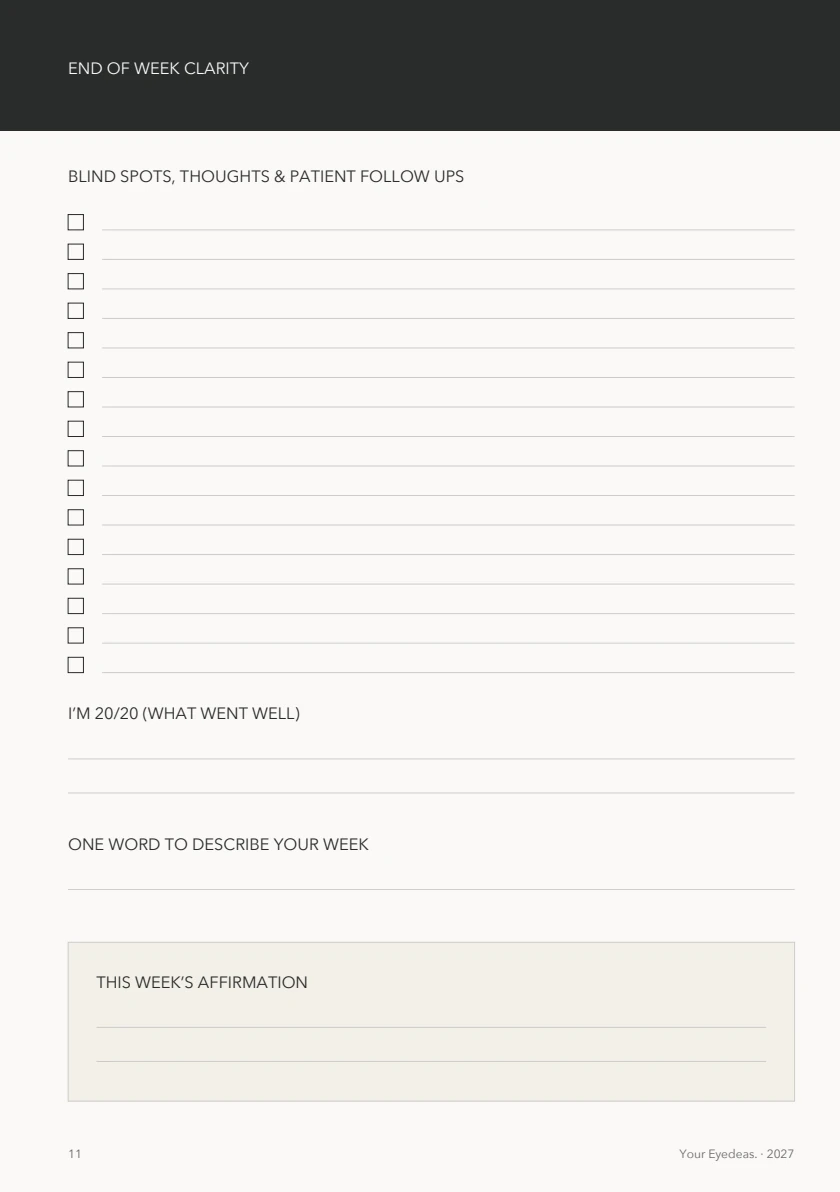
FOR THE PERSON BEHIND THE APPOINTMENTS
Working in eye care can mean full clinics, detailed decisions, admin and conversations with people who feel worried. It can be stressful, and there are days when the work follows you home.
It can also be deeply rewarding: helping someone understand their eye care, supporting a colleague, learning a new skill or noticing the difference a thoughtful conversation made.
These pages make room for both. You can recognise what felt difficult and still notice what mattered. Your journal can hold your life outside work, too.
01 / A SIMPLE START
Open “End of Week Clarity”. Start with these three prompts, then add more only if you want to.
How did this week feel?
“Stretched.” “Proud.” “Learning.”
What did you do that mattered?
“I took time to explain something clearly.”
What would help you meet next week?
“I can pause and ask for support.”
Missed a week? Just start on the page you’re on.
02 / MAKING THE PAGES YOUR OWN
YOUR MONTH IN VIEW
Use the two-page calendar for clinics, important dates and time outside work. Give the things that matter to you a place alongside appointments.
“Annual leave.” “CPD evening.” “Dinner with friends.”
THIS MONTH’S FOCUS & GOALS
Write what you would like to give attention to. Use “From vision to action” to turn it into small, manageable steps.
“Build my confidence explaining things” → “Ask a colleague for feedback on one explanation.”
YOUR WEEK AHEAD
Plan Monday to Sunday with work, everyday tasks and something to look forward to. You can leave space for the unexpected.
“Clinic.” “Prepare for tomorrow.” “Walk after work.”
BLIND SPOTS, THOUGHTS & PATIENT FOLLOW UPS
Use the tick boxes for general reminders, learning questions and unfinished tasks. Keep patient names, identifying details and clinical records in your secure practice system.
“Check my admin query has been answered.” “Ask about a learning point.”
I’M 20/20 (WHAT WENT WELL)
A win doesn’t have to be a big achievement. Think about your effort, a useful conversation or a moment when you felt proud.
“I asked for a second opinion.” “I supported a colleague during a busy clinic.”
ONE WORD TO DESCRIBE YOUR WEEK
Choose the word that fits, without judging it. It’s a quick snapshot of how the week felt to you.
“Rewarding.” “Demanding.” “Steady.” “Mixed.”
03 / THIS WEEK’S AFFIRMATION
An affirmation is a short, supportive sentence you choose to return to. It can remind you of a value, recognise your effort or help you approach the week with a little more kindness.
Keep it believable. You don’t need to pretend a difficult day was easy. “I’m learning, and I can ask for help” may feel more useful than “I always get everything right.”
Try starting with “I can…”, “I’m allowed to…” or “I’m learning to…”.
WHAT WOULD YOU LIKE TO REMEMBER?
“I can pause, ask for support and take the next step.”
A reminder for a week that asks a lot of you.Borrow these words, change them or write something that sounds like you.
YOUR NOTES / NO RIGHT WAY
A question you want to explore, a small eyedea, something you’re grateful for or a thought you want to leave on the page. Your notes can be messy, brief or unfinished.
You don’t have to turn every reflection into a task.
FROM KRUPA’S BOOKSHELF
A recent read I’ve loved is The Power of Being Perfectly Imperfect by fellow optometrist Sheena Tanna-Shah. Its invitation to embrace imperfection feels close to the spirit of your eyedeas.
In eye care, we spend so much of the day looking after others. Your journal can be a place to check in with yourself, too — to acknowledge what felt hard, recognise your effort and think about the support you need.
A FEW EYEDEAS TO EXPLORE
These are our own journaling prompts, offered alongside a personal reading recommendation.
Explore Sheena’s book ↗04 / A FEW QUESTIONS
No. You might plan at the start of the week and reflect at the end, or use the pages whenever they feel useful. Choose a rhythm that fits your life.
Look for effort rather than a perfect outcome. Perhaps you asked for help, listened carefully or made time for a colleague. A small moment is enough.
Use the box for a grounded intention instead: “This week, I’ll ask for help sooner” or “I’ll notice one thing that went well.” You can also leave it blank.
Of course. This is your planner. Your friendships, routines, rest and hopes deserve space here, too.
ONE PAGE AT A TIME
There’s no perfect way to fill these pages.
There’s the way that works for you.